



China’s Supreme People’s Procuratorate published a landmark case on June 7 in which prosecutors in Qingdao successfully argued that Bitcoin qualifies as legally protected property under the country’s criminal law — sentencing a thief to nearly 11 years in prison for stealing 107 Bitcoin — in a ruling that creates a striking legal contradiction at the heart of Beijing’s five-year-old blanket crypto ban.
The case, published on the Supreme People’s Procuratorate’s official website under the headline “107 Bitcoins Disappeared,” centers on a defendant identified only by the surname Zhang. According to the court documents, Zhang obtained the victim’s cryptocurrency wallet recovery phrase and used it to transfer and sell 107 Bitcoin belonging to the victim — an act the Qingdao prosecutors successfully prosecuted as theft of property under Chinese criminal law, per the SPP’s official account of the case.
Zhang was sentenced to ten years and nine months in prison and fined 100,000 yuan — approximately $13,800 — per the official ruling. The value of the stolen property was calculated based on the 660,000 yuan, or roughly $91,000, that Zhang received from liquidating the Bitcoin after the theft.
The prosecution’s core legal argument was that Bitcoin satisfies the statutory definition of property under Chinese criminal law because it holds demonstrable economic value and can be exclusively controlled by its owner — two criteria that define protectable property interests under the Chinese legal framework.
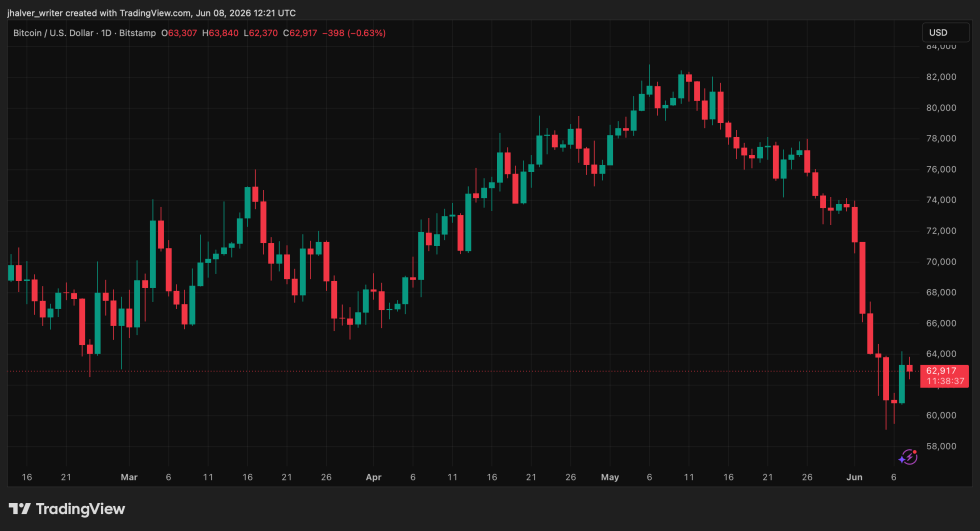
BTC's price records small gains over the weekend, as seen on the daily chart. Source: BTCUSD chart on Tradingview
The Contradiction At The Center Of Chinese Crypto Law
The Qingdao ruling places Beijing’s legal system in an uncomfortable but increasingly documented position. China’s September 2021 blanket ban — jointly issued by ten regulatory bodies including the People’s Bank of China — declared all cryptocurrency transactions illegal, effectively prohibiting trading, exchanges, and mining across the country.
In May 2026, China expanded that crackdown to explicitly cover stablecoins, RWA tokenization, and offshore yuan-pegged digital currencies, with a two-year rectification deadline for all unauthorized cross-border financial channels.
Yet Chinese courts have simultaneously and consistently affirmed Bitcoin’s status as protected property in criminal proceedings. A Shanghai court ruled in 2024 that crypto ownership is legal under Chinese law, per the South China Morning Post. The Shanghai Second Intermediate People’s Court previously described Bitcoin as a “unique and non-replicable” asset with clear financial attributes.
And now the Supreme People’s Procuratorate — China’s highest prosecutorial authority — has published the Qingdao case as a model ruling, signaling to prosecutors nationwide that this is the correct framework for handling Bitcoin theft cases.
Why The SPP Published This Case
Publication by the Supreme People’s Procuratorate is not routine reporting. Cases featured on the SPP’s official platform are selected as guidance for lower-level prosecutors and courts handling similar matters across China’s 34 provincial-level jurisdictions.
By highlighting the Qingdao case, Beijing’s highest prosecutorial body is effectively issuing an instruction: when Bitcoin is stolen, prosecute it as property theft and value it at market rates. That instruction operates regardless of — and in direct tension with — the trading and transaction ban that nominally makes Bitcoin illegal to hold or transfer in China.
The legal architecture this creates is genuinely novel. China simultaneously tells its citizens they cannot buy, sell, or trade Bitcoin — and tells its courts that if someone steals it, the full weight of criminal law will protect the victim’s property rights. The nascent sector has never encountered a major jurisdiction that bans its use and protects its ownership simultaneously at the highest legal level.
This development marks a pivotal and legally complex moment for Bitcoin’s global status. A ruling published by China’s Supreme People’s Procuratorate confirming Bitcoin as legally protected criminal property — in a country that officially bans its use — is not a minor jurisdictional footnote. It is a signal that even the world’s most restrictive crypto regime cannot fully escape the legal reality of what Bitcoin is.
Cover image from Grok, BTCUSD chart from Tradingview
Editorial Process for bitcoinist is centered on delivering thoroughly researched, accurate, and unbiased content. We uphold strict sourcing standards, and each page undergoes diligent review by our team of top technology experts and seasoned editors. This process ensures the integrity, relevance, and value of our content for our readers.