




Bitcoin rallied hard after Iran said it was reopening the Strait of Hormuz to commercial shipping.
Bitcoin hit the highest level since February, oil prices dropped, Wall Street notched another record, and the U.S. 10-year Treasury yield slipped to 4.24%. But here’s the catch: markets acted as if the reopening had solved the core standoff between Washington and Tehran.
Look closer, though, and the story gets more complicated. The opening is only temporary, the blockade is still in place, mine-clearing operations are ongoing, and there’s plenty of confusion about what Iran has actually agreed to.
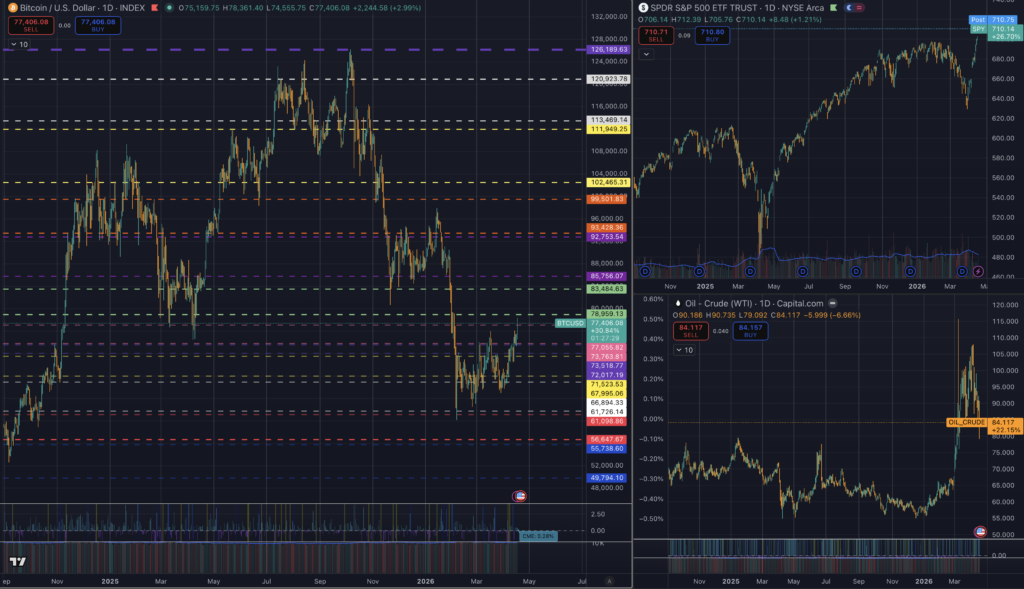
That matters even more heading into the weekend. U.S. stocks, Treasuries, and most major markets shut down after Friday, but Bitcoin keeps trading.
So once again, Bitcoin becomes the first big, liquid market to test whether Friday’s rally was built on real progress or just hope.
The public messaging from Washington also leaves room for a reversal. Trump told Axios he expects a deal “in a day or two”, and the same report said the outline under discussion could involve the U.S. releasing $20 billion in frozen Iranian funds in exchange for Tehran giving up its enriched uranium.
The Washington Post reported that Iran had not confirmed Trump’s claim that it would hand over what he calls “nuclear dust,” while also noting that earlier U.S. claims about Iranian commitments had already proved unreliable or had fallen apart.
The deal narrative is already under strain
Tehran’s public posture still sits well short of the version of events that calmed markets. In the Al Jazeera liveblog, Foreign Ministry spokesperson Esmaeil Baghaei was quoted as rejecting any transfer of enriched uranium to the United States and dismissing U.S. statements on Hormuz as contradictory.
Even before that, Tasnim reported on April 15 that Baghaei was still defending enrichment as a non-negotiable sovereign right.
There’s still a big gap between what traders are hoping for and what’s actually been agreed to. Friday’s rally made sense as a relief move: an open Strait of Hormuz means less immediate risk for oil.
But it’s a stretch to say the big issues, like uranium, compensation, or the Lebanon ceasefire, are anywhere close to settled. That gap is hard to ignore. Trump said the American blockade on Iranian ships and ports will stay in place until Tehran reaches a deal with Washington, including on its nuclear program.
So while the Strait might be open for some ships, the bigger restrictions haven’t gone anywhere.
That’s the real setup as we head into the weekend. Oil finished lower, stocks hit new highs, and investors felt bolder, but the story behind those moves is still shaky.
We’ve seen optimism turn into doubt more than once during this conflict. The question now is whether this latest rally can actually last.

Shipping and oil have improved, but they have not normalized
The physical market is still flashing caution. Back on April 11, CENTCOM said U.S. forces were preparing for mine-clearing in the strait, with more equipment and underwater drones on the way.
If traders really thought the Strait was back to normal, they wouldn’t still be glued to live mine-clearing updates, with shipping firms still cautious of crossing.
The last ceasefire window showed just how slow the shipping recovery can be. Only five ships made it through on Wednesday and seven on Thursday, while more than 600 vessels, including 325 tankers, were still stuck in the Gulf. Daily passage was still just 10 to 15 ships, far below the 120 to 140 before the conflict.
Friday’s late reality check didn’t really change that picture. Kpler still saw ship movement limited to approval-based corridors on Friday evening, hours after the full reopening claims, and warned that getting back to normal could take months, not weeks.
Maersk had already said in its own update that even with ceasefire news, there’s no guarantee of smooth sailing. Every transit decision is still a judgment call.
That’s why Friday’s oil drop made sense, but also why it’s fragile. U.S. crude closed at $82.59 and Brent at $90.38, a big turnaround from the stress earlier this month.
But those prices are still higher than before the conflict, and they don’t prove that shipping is back to normal or that the risk premium has disappeared for good.
The other big channel is interest rates. Friday’s oil drop helped pull the U.S. 10-year yield down to 4.24%, easing a bit of pressure just before the weekend.
But as CryptoSlate pointed out previously, if energy shocks keep coming, the next round of market moves could show up in government bond yields as well as oil prices.
That still matters because if oil bounces back over the weekend, the whole inflation and liquidity debate will be back on the table by Monday.
Bitcoin becomes the live weekend test
Bitcoin sits right in the middle of all this. It keeps trading while stocks and bonds are closed, and while most big markets are waiting for Monday to roll around.
That makes Bitcoin the first place traders can show whether they think Friday’s news was real progress or just another pause built on mixed messages. That’s especially important given how traders are positioned.
CryptoSlate’s first look on Friday showed the rally was fueled by a surge in short liquidations and a shift toward more bullish bets. A squeeze like this can keep going if the story holds up, but it can also unwind quickly if the news turns out less solid than traders had hoped.
| Weekend trigger | What it would signal | First likely BTC read |
|---|---|---|
| Tehran repeats the uranium denial or talks visibly stall | Friday likely priced rhetoric faster than diplomacy | Higher risk of BTC handing back part of the relief move toward $73k |
| The Lebanon ceasefire holds and ship trackers show more approved movement | Markets can keep extending the de-escalation window | Better odds that BTC holds the mid-$70,000s and tests $79k resistance |
| A maritime incident, shipping slowdown or renewed regional strike appears | Physical risk reasserts itself before cash markets reopen | BTC likely becomes the first liquid stress gauge of the reversal toward $70k |
The constructive case for the weekend is pretty simple. If there’s no new military escalation, if Tehran and Washington keep the rhetoric from getting worse, and if ship movements improve beyond the controlled corridors Kpler has been tracking, then Bitcoin can continue to serve as a de-escalation asset.
In that case, Friday’s squeeze was just the first leg of a cleaner repricing, not just a reflexive bounce into the close.
The bearish case is just as clear. If Iran’s pushback grows from denial into a visible collapse in talks, or if the Lebanon ceasefire starts to fray and undermines the political basis for opening Hormuz, then the market will have to rethink the oil risk premium it just removed.
Bitcoin would then be trading alone through the weekend as the first broad risk proxy available to price that gap is easing. But it didn’t prove that Washington and Tehran have settled the arguments that matter most.
Bitcoin heads into the April 18-19 weekend as a live relay for unresolved macro risk. The real signal will come from what happens after the headlines, on the water, in the talks, and in crude itself.