




Bitcoin’s price is still trading far above the depths of past bear markets, and that distance is now making the current moment feel pretty disorienting. Under the surface, a huge share of the market is already back in pain.
On-chain data show that by early April, roughly 46% of Bitcoin’s supply was being held at a loss, meaning that nearly half of the coins on the network were last bought at prices above the current market price.
Markets tend to get emotionally unstable when large numbers of people are trapped in losing positions, and the gap between what a price chart shows and what the holder base actually feels can be quite large.
That’s why the $60,000 level stands out. The number itself is all nice and round and memorable, but its real importance is in how it affects behavior. A move back there would pull even more of the market underwater and turn a slow grind lower into a vertical drop, a direct test of whether holders keep waiting or finally start selling.
People who bought during the run-up have long since shifted their attention from the next all-time high to harder questions: whether they misread the market, whether they should cut risk, and whether this drawdown has further to run. That’s the territory where bottoms tend to form, and where panic, once it finds a foothold, tends to spread.
The deeper floor is still standing
The market is hurting, and the underlying levels that defined older cycle washouts are still holding.
The best example of this is the realized price, one of Bitcoin’s simplest long-term anchors. It represents the average price at which the network’s coins last changed hands, and it currently sits near $54,100. Bitcoin remains above it even after this slide, which means the average holder across the whole network is still not carrying any losses.
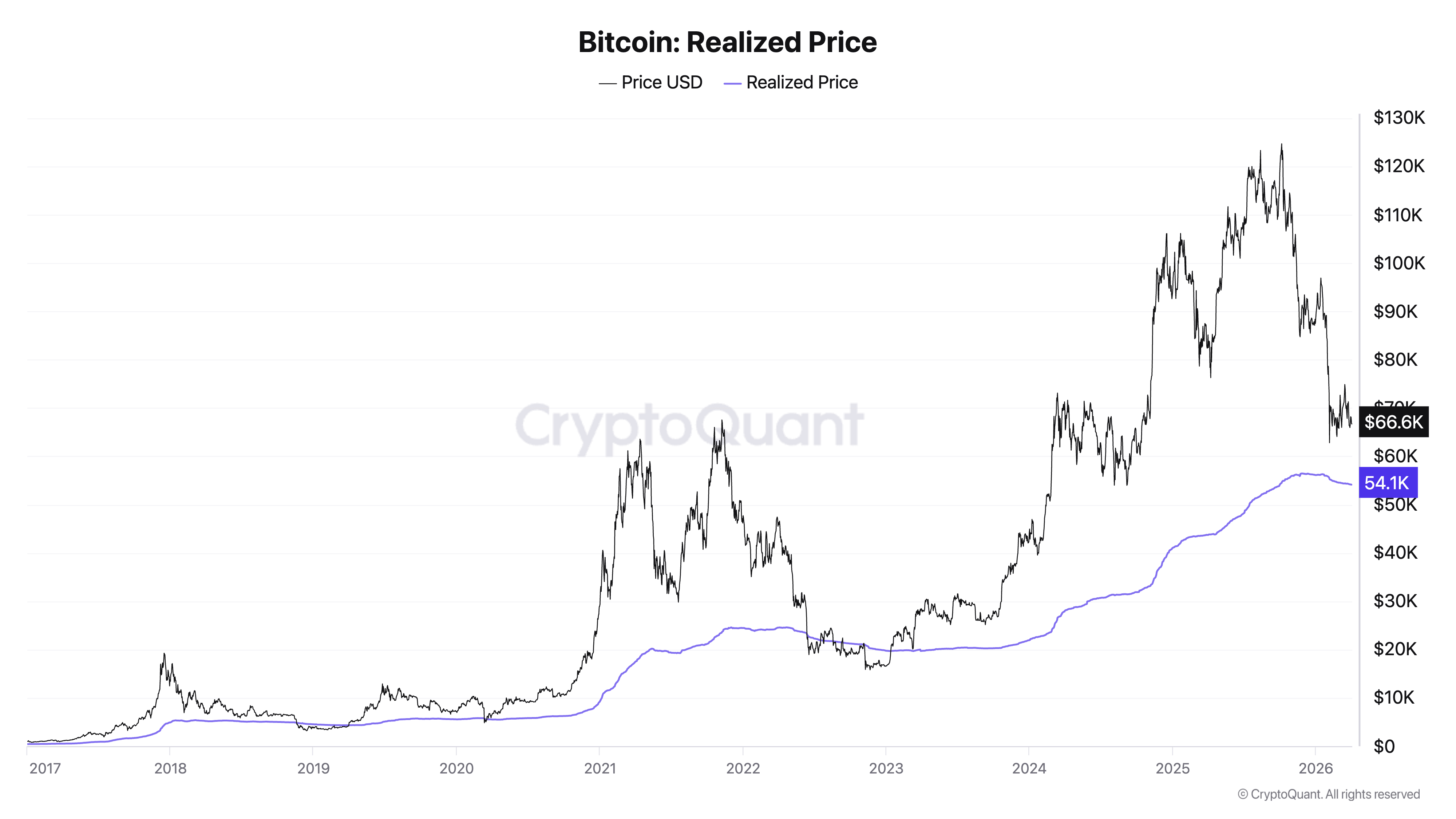
The weekly chart confirms this. Bitcoin is also holding above its 200-week moving average, which sits around the high $50,000s, leaving the market in a very unusual position. It feels weak enough to scare people, sour sentiment, and leave a very large share of holders in the red, while the foundational levels that past bear markets reached remain intact.
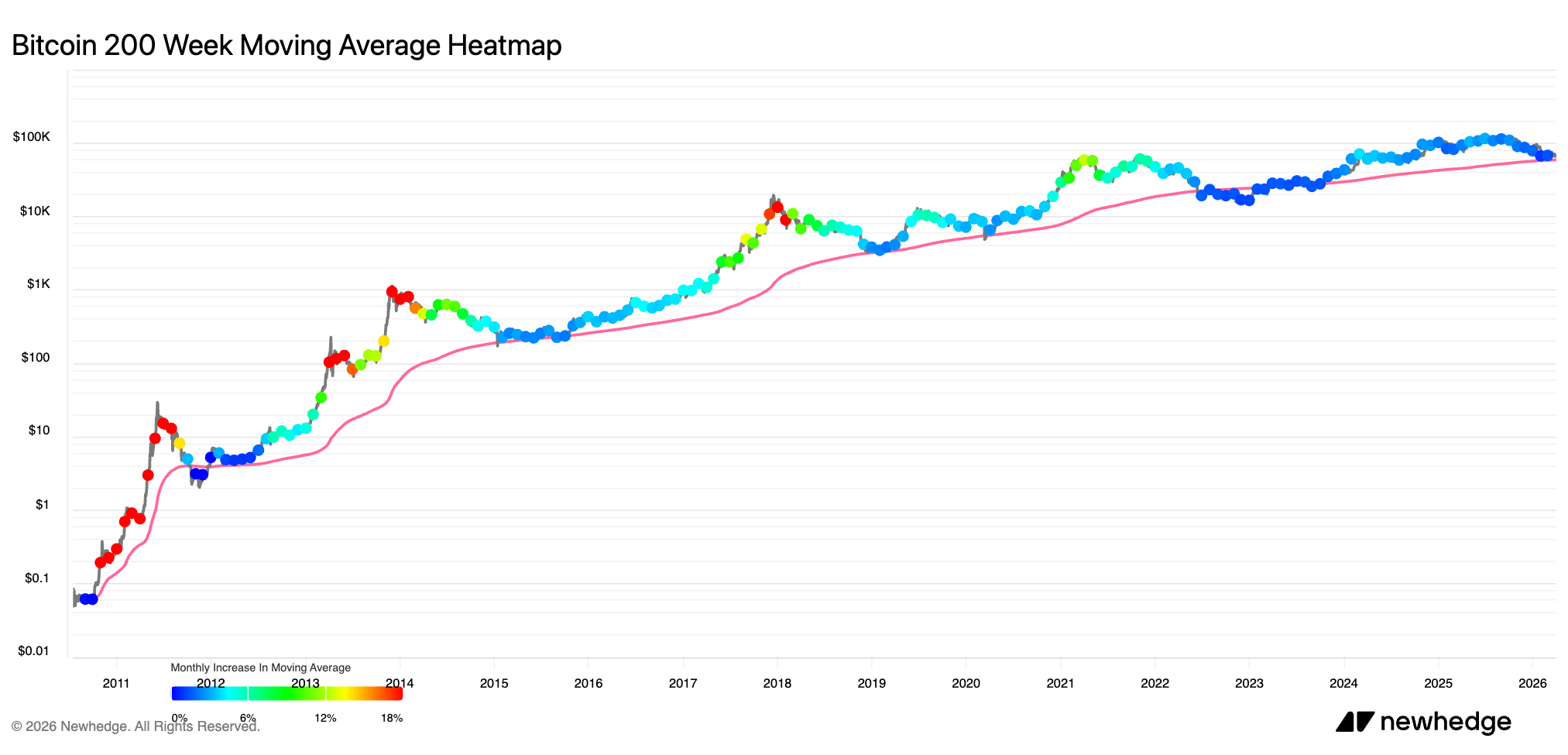
That distinction may be the clearest difference between this cycle and earlier ones. Bitcoin still behaves like a volatile asset, and drawdowns still inflict real damage, but the altitude at which that damage is occurring has risen considerably. The pain is happening higher up the chart than it used to.
That elevation likely comes from a broader and sturdier owner base. Bitcoin has attracted more long-duration capital and more institutional exposure over the last few years. That gives the market more structural support than it had in previous cycles, when fear could drag prices straight through every historical floor with very little resistance.
The real question, then, is whether this market can absorb more discomfort before it turns into forced selling.
If Bitcoin falls toward $60,000 and holds, this cycle will have demonstrated something meaningful: nearly half the market is already underwater, and the deeper foundation is still standing. If that level gives way and mass selling begins, it won’t be long before we see the familiar bear-market sequence play out again.
The visible and structural damages are operating on different levels right now. Bitcoin can still appear relatively fine on a long-term chart while a huge share of holders already feels squeezed, and for anyone watching from outside the asset, that tension is the most useful way to understand the moment.
The market is absorbing a serious amount of pressure, and the question of how much more it can take before the foundation shifts is one that the next few weeks will start to answer.
At the time of press 3:27 pm UTC on Apr. 3, 2026, Bitcoin is ranked #1 by market cap and the price is up 0.64% over the past 24 hours. Bitcoin has a market capitalization of $1.34 trillion with a 24-hour trading volume of $30.11 billion. Learn more about Bitcoin ›
Crypto Market Summary
At the time of press 3:27 pm UTC on Apr. 3, 2026, the total crypto market is valued at at $2.3 trillion with a 24-hour volume of $74.01 billion. Bitcoin dominance is currently at 58.05%. Learn more about the crypto market ›